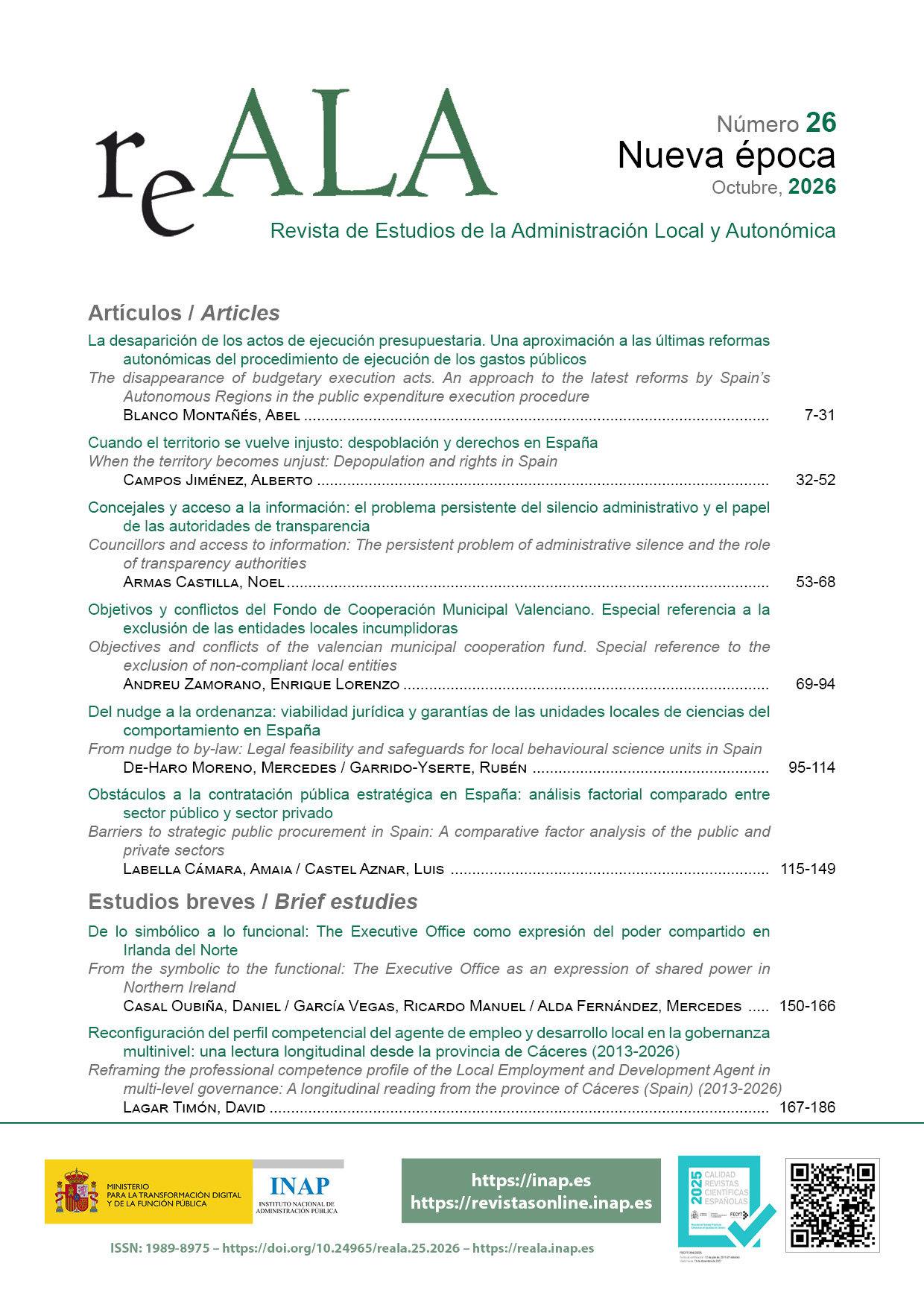
From nudge to by-law: Legal feasibility and safeguards for local behavioural science units in Spain
DOI:
https://doi.org/10.24965/reala.11642Keywords:
behavioural sciences, local government, good administration, public sector innovation, policy evaluation, public ethics, transparency, administrative simplificationAbstract
Objectives: To identify the legal, organisational and ethical conditions under which a Local Behaviour and Innovation Unit (LBIU) may be institutionalised in Spanish municipalities and to formulate a gradual implementation model. Methodology: The article uses a legal-dogmatic and legal-propositional approach, supplemented by a directed documentary review of academic and institutional literature and a selective comparison of three experiences. Cases were selected according to diversity of government level, existence of an institutional mandate, availability of official sources and relevance to local government. The comparison is exploratory and does not, by itself, establish transferability. Results: The current legal framework permits LBIUs to be articulated through existing instruments, but the appropriate route depends on whether the initiative is a functional team, a stable administrative unit, an organisational modification or the incorporation of measures into by-laws and regulations. Feasibility requires identifying the competent body, legal instrument, human and budgetary resources, data governance, evaluation and ethical safeguards. Conclusions: LBIUs are legally possible on a conditional, rather than automatic, basis. Their legitimacy depends on proportionality, transparency, reversibility, protection of vulnerable groups and adaptation of comparative learning to the Spanish municipal context.
Downloads
References
Behavioural Insights Team (2021). Economy BIT review 2021–2022. Behavioural Insights Team. https://www.bi.team/press-releases/behavioural-insights-team-publishes-review-for-2021-2022/
Bovens, L. (2009). The ethics of nudge. En T. Grüne-Yanoff y S. O. Hansson (eds.), Preference change: Approaches from philosophy, economics and psychology (pp. 207-219). Springer. https://doi.org/10.1007/978-90-481-2593-7_10
Cabrales Goitia, A. y Rey Biel, P. (2021). Más allá de los nudges: Políticas públicas efectivas basadas en la evidencia de las ciencias del comportamiento. Gestión y Análisis de Políticas Públicas, 25, 38-45. https://doi.org/10.24965/gapp.i25.10864
Comisión Nacional de los Mercados y la Competencia (2025). Estudio sobre la economía conductual para una regulación y supervisión eficientes (E/CNMC/002/23). CNMC. https://www.cnmc.es/sites/default/files/6130089.pdf
Comité Económico y Social Europeo – CESE (2017). Dictamen sobre «Integrar los nudges en las políticas europeas» [Diario Oficial de la Unión Europea, C 75]. https://eur-lex.europa.eu/legal-content/EN/TXT/?uri=CELEX:52016IE1333
Dolowitz, D. P. y Marsh, D. (2000). Learning from abroad: The role of policy transfer in contemporary policy-making. Governance, 13(1), 5-23. https://doi.org/10.1111/0952-1895.00121
Drummond, J., Shephard, D. y Trnka, D. (2021). Behavioural insight and regulatory governance: Opportunities and challenges [OECD Regulatory Policy Working Papers n.º 16]. OECD Publishing. https://dx.doi.org/10.1787/ee46b4af-en
Evans, M. (2009). Policy transfer in critical perspective. Policy Studies, 30(3), 243-268. https://doi.org/10.1080/01442870902863828
Güemes, C. (2021). Políticas conductuales. Eunomía: Revista en Cultura de la Legalidad, 20, 310-321. https://doi.org/10.20318/eunomia.2021.6078
Hallsworth, M., Egan, M., Rutter, J. y McCrae, J. (2018). Gobierno conductual: Aplicación de las ciencias del comportamiento para mejorar la toma de decisiones de los gobiernos. The Behavioural Insights Team. https://www.bi.team/publications/gobierno-conductual/
Halpern, D. (2015). Inside the nudge unit: How small changes can make a big difference. WH Allen.
Hertwig, R. y Grüne-Yanoff, T. (2017). Nudging and boosting: Steering or empowering good decisions. Perspectives on Psychological Science, 12(6), 973-986. https://doi.org/10.1177/1745691617702496
Lunn, P. (2014). Regulatory policy and behavioural economics. OECD Publishing. https://doi.org/10.1787/9789264207851-en
Martín Delgado, I. (2009). Naturaleza, concepto y régimen jurídico de la actuación administrativa automatizada. Revista de Administración Pública, 180, 353-386. https://www.cepc.gob.es/publicaciones/revistas/revista-de-administracion-publica/numero-180-septiembrediciembre-2009/naturaleza-concepto-y-regimen-juridico-de-la-actuacion-administrativa-automatizada-2
Mola, D. J. y Ortiz, M. V. (2024). Editorial: Número especial «Ciencias del comportamiento aplicadas a políticas públicas». Revista Argentina de Ciencias del Comportamiento, 16(1), 1-3. https://doi.org/10.32348/1852.4206.v16.n1.44613
Naru, F. (2024). Behavioral public policy bodies: New developments & lessons. Behavioral Science & Policy, 10(1), 1-17. https://doi.org/10.1177/23794607241285614
National Science and Technology Council, Subcommittee on Social and Behavioral Sciences (2024). Blueprint for the use of social and behavioral science to advance evidence-based policymaking. Executive Office of the President. https://digitalgovernmenthub.org/library/blueprint-for-the-use-of-social-and-behavioral-science-to-advance-evidence-based-policymaking/
OECD (2017). Behavioral insights and public policy: Lessons from around the world. OECD Publishing. https://doi.org/10.1787/9789264270480-en
OECD (2019). Tools and ethics for applied behavioural insights: The BASIC toolkit. OECD Publishing. https://doi.org/10.1787/9ea76a8f-en
OECD (2022). Good practice principles for ethical behavioural science in public policy [OECD Public Governance Policy Papers n.º 20]. OECD Publishing. https://doi.org/10.1787/e19a9be9-en
OECD y New South Wales Government (2024). Fixing frictions: ‘Sludge audits’ around the world. How governments are using behavioural science to reduce psychological burdens in public services [OECD Public Governance Policy Papers n.º 48]. OECD Publishing. https://doi.org/10.1787/5e9bb35c-en
Saghai, Y. (2013). Salvaging the concept of nudge. Journal of Medical Ethics, 39(8), 487-493. https://doi.org/10.1136/medethics-2012-100727
Service, O., Hallsworth, M., Halpern, D., Algate, F., Gallagher, R., Nguyen, S., Ruda, S., Sanders, M., Pelenur, M., Gyani, A., Harper, H., Reinhard, J. y Kirkman, E. (2014). EAST: Four simple ways to apply behavioural insights. The Behavioural Insights Team. https://www.bi.team/publications/east-four-simple-ways-to-apply-behavioural-insights/
Subirats, J. (2016). El poder de lo próximo: Las virtudes del municipalismo. Catarata.
Subirats, J. y García Bernardos, Á. (2015). Innovación social y políticas urbanas en España. Experiencias significativas en las grandes ciudades. Icaria.
Sunstein, C. R. (2014). Why nudge? The politics of libertarian paternalism. Yale University Press.
Thaler, R. H. y Sunstein, C. R. (2008). Nudge: Improving decisions about health, wealth, and happiness. Yale University Press.
Varazzani, C., Tuomaila, H., Emmerling, T., Brusoni, S. y Fontanesi, L. (2023). Seven routes to experimentation in policymaking: A guide to applied behavioural science methods [OECD Working Papers on Public Governance n.º 64]. OECD Publishing. https://doi.org/10.1787/918b6a04-en
White, M. D. (2013). The manipulation of choice: Ethics and libertarian paternalism. Palgrave Macmillan. https://doi.org/10.1057/9781137313577
World Health Organization (2022). Behavioural sciences for better health initiative.WHO. https://www.who.int/publications/m/item/behavioural-sciences-for-better-health-initiative
Downloads
Published
How to Cite
Issue
Section
License
Copyright (c) 2025 Revista de Estudios de la Administración Local y Autonómica

This work is licensed under a Creative Commons Attribution-NonCommercial 4.0 International License.