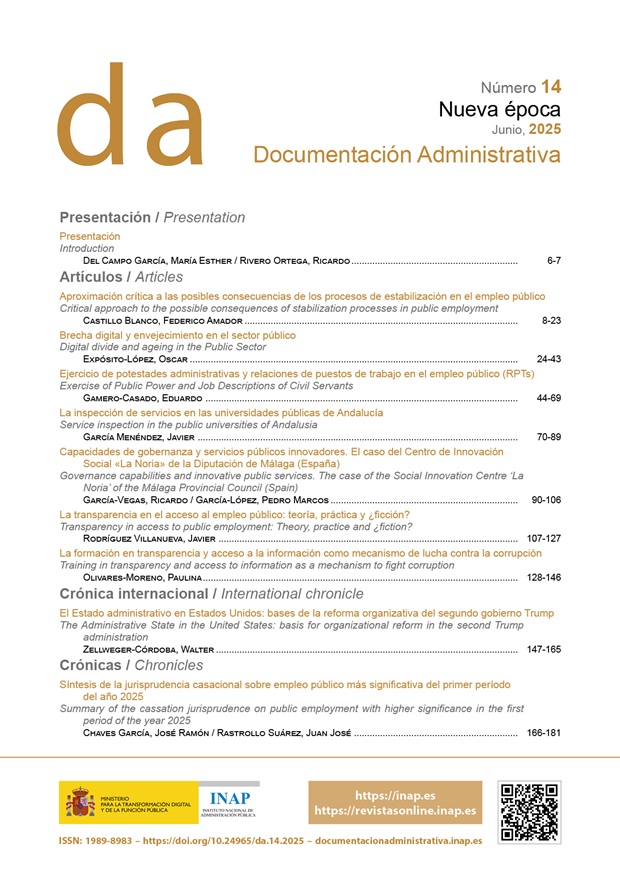
The Administrative State in the United States: basis for organizational reform in the second Trump administration
DOI:
https://doi.org/10.24965/da.11537Keywords:
Administrative state, administrative reform, Department of Government Efficiency, DOGE, federal civil service, United States public administration, unitary executive, administrative organization, government efficiencyAbstract
Objectives: The purpose of this article is to study and publicize the programmatic bases that articulate the organizational reform of the Federal government of the United States undertaken in the first months of the second Trump administration’s through the Department of Government Efficiency (DOGE). Methodology: The analysis of the approved rules affecting the Federal Government organization and the federal civil service, in addition to the judicial documentation of some of the first controversies that have been arised. Results: The finding that a radical and controversial transformation of the Government organization has been projected, tending towards greater politicization and the weakening of its structures. Conclusions: The will of the Trump administration to initiate a period of retrogression in the Government, which will affect its organizations and human resources alike for the transition towards a politicized, reduced and centralized apparatus, subjected to the political direction of the president.
Downloads
References
Breger, M. J. y Edles, G. J. (2000). Established by Practice: The Theory and Operation of Independent Federal Agencies. Administrative Law Review, 52(4), 1111-1294. https://www.jstor.org/stable/40711933
Esteve-Pardo, J. (2024). Loper Bright: una conmoción que se veía venir. La Supreme Court de EE. UU. revoca la doctrina Chevron. Cuadernos de Derecho Regulatorio, (2), 11-27. https://doi.org/10.37417/cudere/vol_2_2024_2660
Fernández-Rojas, G. (2003). La administración por agencias independientes en los Estados Unidos de América. Vniversitas, 52(106), 177-205. https://revistas.javeriana.edu.co/index.php/vnijuri/article/view/14813
García de Enterría, E. (2007). La administración española: estudios de ciencia administrativa (7.ª ed.). Civitas.
García-Trevijano, J. A. (1971). Tratado de derecho administrativo [tomo II, vol. I]. Editorial Revista de Derecho Privado.
Martí-Sánchez, S. (2006). Las agencias administrativas en Estados Unidos: en la encrucijada de poderes. Revista de las Cortes Generales, (67), 97-138. https://doi.org/10.33426/rcg/2006/67/551
Marx, F. M. (1962). El Estado administrativo. Documentación Administrativa, (49), 89-94. https://doi.org/10.24965/da.vi49.1819
Moynihan, D. P. (2022). Public Management for Populists: Trump’s Schedule F Executive Order and the Future of the Civil Service. Public Administration Review, 82(1), 174-178. https://doi.org/10.1111/puar.13433
Moynihan, D. P. y Roberts, A. (2021). Dysfunction by Design: Trumpism as Administrative Doctrine. Public Administration Review, 81(1), 152-156. https://doi.org/10.1111/puar.13342
Muñoz-Machado, S. (2017). Tratado de derecho administrativo y de derecho público general [vol. X], (5.ª ed.). Boletín Oficial del Estado. https://www.boe.es/biblioteca_juridica/publicacion.php?id=PUB-PB-2015-73
Pérez-Alonso, J. (2024). Mutaciones jurisprudenciales en torno a la organización y control judicial de las agencias administrativas en Estados Unidos. Revista de Administración Pública, (223), 277-300. https://doi.org/10.18042/cepc/rap.223.11
Rivero-Ortega, R. (2025). La función pública del futuro: ¿bots expertos en promptear? El Consultor de los Ayuntamientos, 13(4), 1-11. https://elconsultor.laley.es/Content/Documento.aspx?params=H4sIAAAAAAAEAMtMSbF1CTEAAhMLU0szI7Wy1KLizPw8WyMDI1MDY0NzkEBmWqVLfnJIZUGqbVpiTnEqAAFm_os1AAAAWKE
Solum, L. B. (2011). What is Originalism? The Evolution of Contemporary Originalist Theory. Georgetown Law Faculty Publications and Other Works, artículo 1353. http://dx.doi.org/10.2139/ssrn.1825543
Strauss, P. L. (1984). The place of agencies in government: Separation of powers and the Fourth Branch. Columbia Law Review, 84(3), 573-669. https://doi.org/10.2307/1122501
Sunstein, C. R. (2013). The Office of Information and Regulatory Affairs: Myths and Realities. Harvard Law Review, 126(7), 1838-1878. https://harvardlawreview.org/print/vol-126/the-office-of-information-and-regulatory-affairs-myths-and-realities/
Sunstein, C. R. y Lessig, L. (1994). The President and the Administration. Columbia Law Review, 94(1), 1-123. https://doi.org/10.2307/1123119
Downloads
Published
How to Cite
Issue
Section
License
Copyright (c) 2025 Documentación Administrativa

This work is licensed under a Creative Commons Attribution-NonCommercial 4.0 International License.