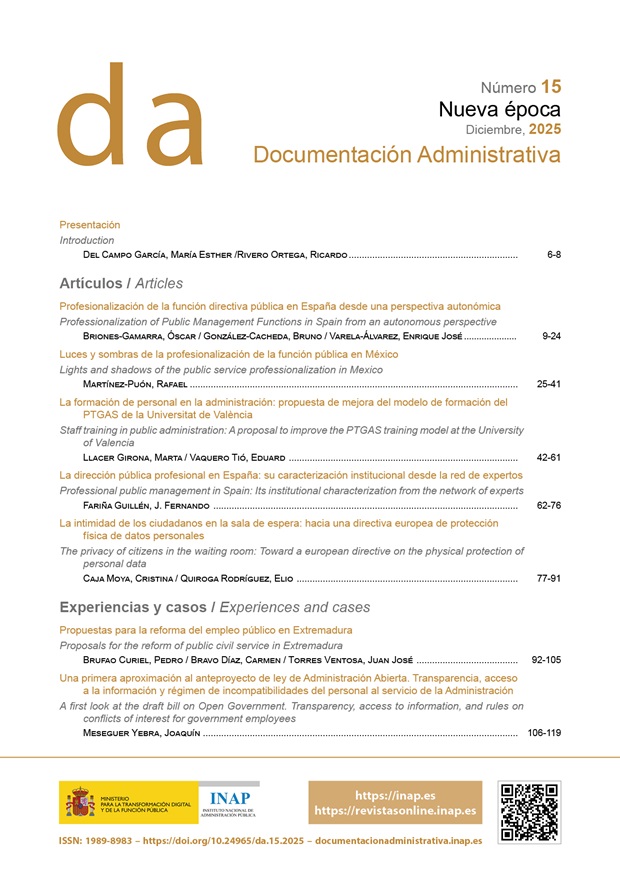
The privacy of citizens in the waiting room: Toward a european directive on the physical protection of personal data
DOI:
https://doi.org/10.24965/da.11601Keywords:
privacy in public spaces, administrative negligence, applied GDPR, public administration, European directiveAbstract
Objectives: The paper seeks to highlight and critique the disconnection between the development of advanced digital regulatory frameworks –such as the 2025-2030 Strategic Plan of the Spanish Data Protection Agency (AEPD), focused on artificial intelligence and technological innovation– and the persistent violation of the right to privacy in the physical spaces of public administrations. It also aims to encourage reflection on the need to extend data protection beyond the digital environment. Methodology: A critical and comparative analysis is conducted between current public data protection policies and the actual practices observed in physical spaces of citizen service. The study examines examples from hospitals, employment offices, and tax agencies, contrasting the public sector’s shortcomings with the progress made in the private sector, particularly in banking. Results: The analysis reveals structural negligence in the protection of privacy within public physical spaces. Individuals, often in vulnerable situations, are forced to surrender their privacy in order to access basic services. The study identifies an institutional short-sightedness that prioritizes bureaucratic efficiency over human dignity, perpetuating a model of service that disregards fundamental principles of data protection. Conclusions: The study proposes a roadmap of mandatory measures to reverse this situation: a) Incorporate privacy impact assessments into the design of public spaces. b) Develop specialized training for administrative personnel. c) Implement minimum architectural safeguards to ensure confidentiality. All these measures should be framed under the principle of «privacy by design» with the aim of inspiring a future European directive that guarantees the effectiveness of the fundamental right to data protection both in the digital and physical spheres.
Downloads
References
Altman, I. (1977). Privacy regulation: Culturally universal or culturally specific? Journal of Social Issues, 33(3), 66-84. https://doi.org/10.1111/j.1540-4560.1977.tb01883.x
Antón, A. I., Earp, J. B. y Young, J. D. (2010). How internet users’ privacy concerns have evolved since 2002. IEEE Security & Privacy, 8(1), 21-27. https://doi.org/10.1109/MSP.2010.38
Arenas Ramiro, M. (2023). Las obligaciones de transparencia de las autoridades de protección de datos: un requisito indispensable para su independencia. Revista Española de la Transparencia, (17 extra), 227-270. https://doi.org/10.51915/ret.312
Bellanova, R. y González Fuster, G. (2013). Politics of disappearance: Scanners and (unobserved) bodies as mediators of security practices. International Political Sociology, 7(2), 188-209. https://doi.org/10.1111/ips.12017
Burdon, M. y McKillop, A. (2013). The Google Street View Wi-Fi scandal and its repercussions for privacy regulation [Research Paper n.º 14-07]. University of Queensland TC Beirne School of Law. https://ssrn.com/abstract=2471316
Carazo Liébana, M. J. (2023). El derecho fundamental a la protección de datos personales y la responsabilidad proactiva. Aranzadi.
Cavoukian, A. (2009). Privacy by design: The 7 foundational principles. Information and Privacy Commissioner of Ontario, 5(2009).
Clarke, R. (2009). Privacy impact assessment: Its origins and development. Computer Law and Security Review, 25(2), 123-135. https://doi.org/10.1016/j.clsr.2009.02.002
De Hert, P. y Papakonstantinou, V. (2016). The new General Data Protection Regulation: Still a sound system for the protection of individuals? Computer Law & Security Review, 32(2), 179-194. https://doi.org/10.1016/j.clsr.2016.02.006
Edwards, L. y Veale, M. (2017). Slave to the algorithm? Why a «right to an explanation» is probably not the remedy you are looking for. Duke Law & Technology Review, (16), 18-84. https://scholarship.law.duke.edu/dltr/vol16/iss1/2
Flores Cabrera, F. (2023). La protección de datos personales como límite al acceso a la información pública: las condiciones de un equilibrio necesario [trabajo de fin de máster]. Universitat de Barcelona. https://hdl.handle.net/2445/202529
González Fuster, G. (2014). The emergence of personal data protection as a fundamental right of the EU. Springer. https://doi.org/10.1007/978-3-319-05023-2
González Suárez, G. M. (2025). Régimen jurídico de la protección de datos relacionados con la salud [tesis doctoral]. Universidad de Oviedo. https://hdl.handle.net/10651/81113
Hijmans, H. (2016). The mandate of the EU under Article 16 TFEU and the perspectives of legitimacy and effectiveness. En The European Union as guardian of internet privacy: The story of Art. 16 TFEU (pp. 125-183). Springer Cham.
Kosta, E. (2013). Consent in European data protection law [Nijhoff Studies in EU Law, 3]. Brill y Nijhoff.
Lynskey, O. (2015). The foundations of EU data protection law. Oxford University Press.
Lyon, D. (2018). The culture of surveillance: Watching as a way of life. Polity Press.
Nissenbaum, H. (2009). Privacy in context: Technology, policy, and the integrity of social life. Stanford University Press.
Pedraza Córdoba, J. (2023). Responsabilidad proactiva en la gestión de datos personales por administraciones públicas. Tirant lo Blanch.
Piñar Mañas, J. L. (2014). Transparència i dret d’accés a la informació pública. Algunes reflexions al voltant del dret d’accés a la Llei 19/2013, de transparència, accés a la informació i bon govern. Revista Catalana de Dret Públic, (49), 1-19. https://doi.org/10.2436/20.8030.01.29
Puerta Domínguez, E. M. (2023). El marco jurídico de la Unión Europea sobre protección de datos y garantías ciudadanas ante la Administración pública electrónica. Ius et Scientia, 9(1), 23-45. https://doi.org/10.12795/IESTSCIENTIA.2023.i01.03
Reding, V. (2011). The upcoming data protection reform for the European Union. International Data Privacy Law, 1(1), 3-5. https://doi.org/10.1093/idpl/ipq007
Ridaura Martínez, M. J. (2021). Los derechos fundamentales como límites en el marco de la investigación privada. Teoría y realidad constitucional, (47), 129-159. https://doi.org/10.5944/trc.47.2021.30710
Rodríguez Roca, A. (2022). La protección de datos personales en los juzgados y tribunales. Un enfoque desde la perspectiva laboral. La Ley.
Solove, D. J. (2006). A taxonomy of privacy. University of Pennsylvania Law Review, 154(3), 477-564. https://doi.org/10.2307/40041279
Zuboff, S. (2015). Big other: Surveillance capitalism and the prospects of an information civilization. Journal of Information Technology, 30(1), 75-89. https://doi.org/10.1057/jit.2015.5
Downloads
Published
How to Cite
Issue
Section
License
Copyright (c) 2026 Documentación Administrativa

This work is licensed under a Creative Commons Attribution-NonCommercial 4.0 International License.